Health Checkup in Korea for Foreigners (2026): Costs, How to Book and How to Prepare

Ask Koreans in their fifties what they did for their health this year, and many will say the same thing: a full checkup. In Korea a comprehensive health screening is a one-day routine. You arrive fasting in the morning, move from station to station in a hospital gown, and by lunchtime you have had blood work, scans and often an endoscopy. More and more visitors from abroad now plan a trip around one.
This guide covers what a checkup in Korea costs in 2026, where foreigners can book one, which tests are worth adding after 50, and how to prepare. Prices and steps come from the official pages of KMI (Korea Medical Institute), Asan Medical Center and Hanyang University International Hospital.
Quick answer
- Cost: KMI’s packages for foreigners range from ₩500,000 to ₩3,000,000. University hospitals usually cost more.
- Time: most of the tests happen in a single morning.
- Booking: online or by email with the center’s international team, a few weeks ahead.
- Preparation: fast for at least 8 hours, and check with your doctor about blood thinners and weight-loss injections (stop GLP-1 drugs 2 weeks before, per KMI).
- Bring: your passport. You’ll pay on the day.
Why Get a Health Checkup in Korea?
Screening centers in Korea are built for speed and volume. Asan Medical Center’s screening center alone sees more than 40,000 people a year in a dedicated 8,300 m² facility, with separate areas for men and women. Tests that might take several appointments and weeks of waiting elsewhere, such as an abdominal ultrasound, a gastroscopy, a colonoscopy and a CT scan, are done in one visit. Many centers offer interpreters and results in English, and some have hotel-style rooms if you choose a two-day program.
For people over 50, the appeal is simple: the cancer and heart screenings recommended at this age are exactly the tests Korean centers do every day.
Where Can Foreigners Get a Checkup?
There are two main types of places, and the right one depends on your budget and how much hand-holding you want.
| Dedicated screening centers | University hospital centers | |
|---|---|---|
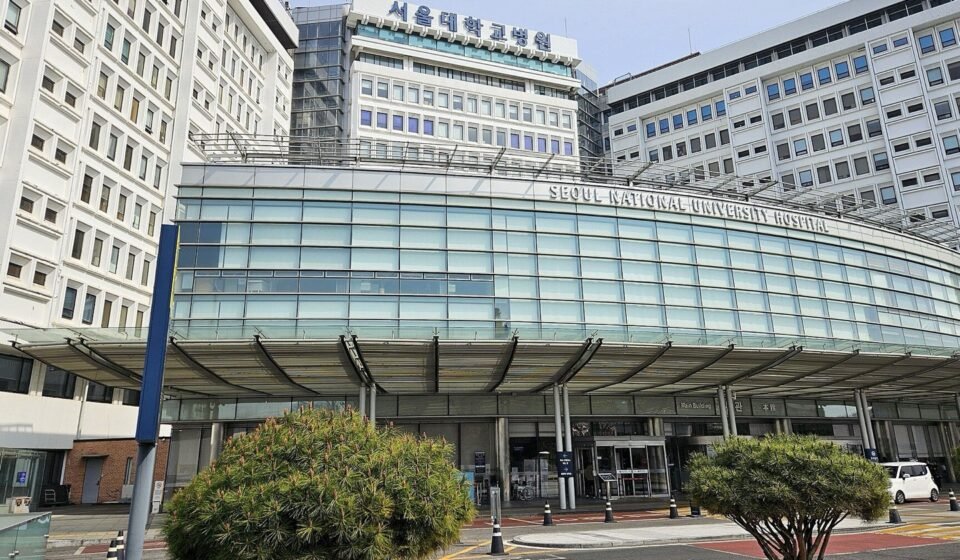
| Examples | KMI (8 centers nationwide, including Seoul, Busan and Jeju) | Asan Medical Center, Samsung Medical Center, Severance, Seoul National University Hospital, Hanyang University International Hospital |
| Price level | Lower, with fixed published packages | Higher, often with more imaging options |
| If something is found | You get a referral to a hospital | Same-hospital referral to specialists |
| Language help | Foreigner programs and multilingual reports | International centers with interpreters |
A few official details worth knowing:
- KMI runs a separate “Global Check up Program” for foreigners, booked only online through its global website (global.kmi.or.kr). Phone help is available in English, Chinese, Japanese and Mongolian.
- Asan Medical Center offers appointment help and interpretation in English, Chinese, Japanese, Russian, Arabic, Vietnamese and Mongolian for patients from abroad.
- Hanyang University International Hospital, which opened in 2003 as Korea’s first international hospital, takes screening requests from foreigners by email (international@hyumc.com) or through its website in English, Russian and Mongolian.
How Much Does a Health Checkup in Korea Cost?
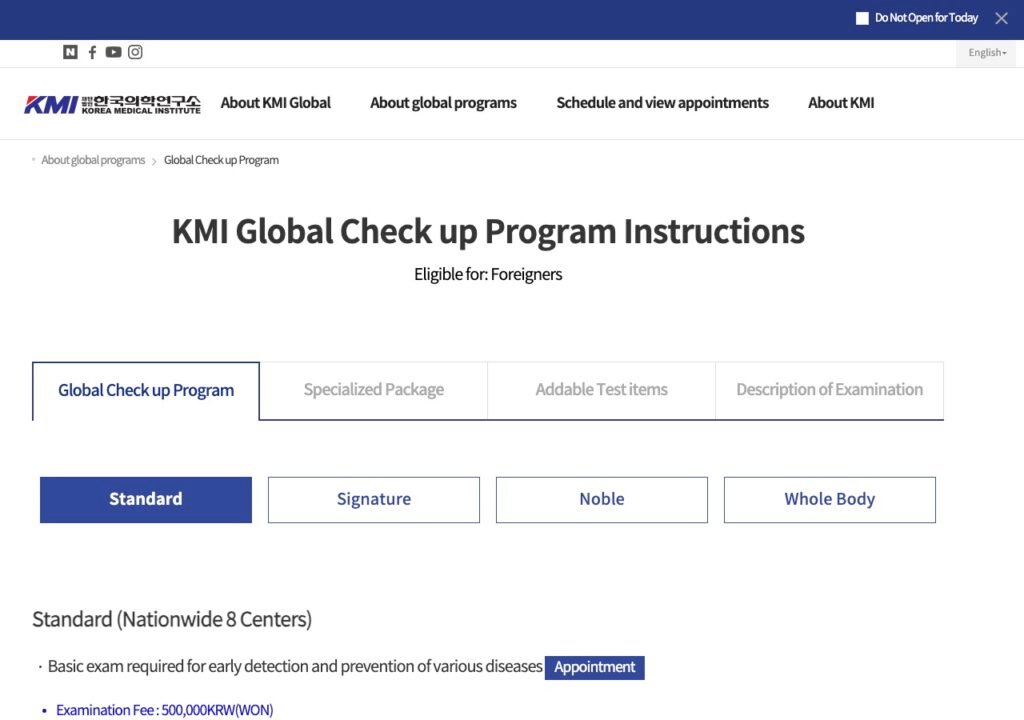
KMI is one of the few centers that publishes its prices for foreigners. As listed on its global site in November 2026:
| Package | Price | What it adds |
|---|---|---|
| Standard | ₩500,000 | Blood and urine tests, tumor markers, ECG, eye pressure and fundus, chest X-ray, abdominal ultrasound, plus a gastroscopy or stomach X-ray |
| Signature | ₩1,000,000 | Standard + prostate or pelvic ultrasound, a colonoscopy (or stool test), and 2 more tests such as thyroid ultrasound, carotid ultrasound, echocardiogram or a CT scan |
| Noble | ₩2,000,000 | Signature + bone density, thyroid, carotid and heart ultrasound, extra blood tests, an MRI or MRA, and a small genetic panel |
| Whole Body | ₩3,000,000 | Noble + more blood tests, a broader genetic panel, imaging CD, pickup service and a 1:1 coordinator |
The fee is paid on site on the day of your checkup, and it isn’t reduced if you skip a test. University hospital packages vary widely and depend heavily on imaging (CT, MRI, PET) and whether endoscopies are done under sedation. Ask the international center for a written quote before you book.
Tests Worth Adding After 50
Which tests you need depends on your history, so talk this through with your own doctor. These are the add-ons people over 50 most often ask about, with KMI’s published add-on prices for reference:
| Colonoscopy (sedated) | ₩210,000. A key colorectal cancer screening for this age group. |
| Lung CT | ₩130,000. Often considered by current or former smokers. |
| Cardiac calcification CT | ₩150,000. Looks for calcium in the heart arteries. |
| Carotid ultrasound | ₩100,000. Checks the neck arteries linked to stroke risk. |
| Echocardiogram | ₩150,000. Heart ultrasound. |
| Thyroid ultrasound | ₩80,000 |
| Brain MRI | ₩400,000 |
KMI notes that add-ons can’t be booked on their own (they go with a package), and that endoscopies, CT, MRI, mammograms and echocardiograms can’t be added on the day. Choose them when you book.
How to Book, Step by Step
1. Pick a center and package
Decide between a screening center and a university hospital, then choose a package and any add-ons. If you have a medical condition, a university hospital makes follow-up easier.
2. Send your request
For KMI, book online on its global site. For university hospitals, email or use the international center’s online form. Include your name as in your passport, date of birth, nationality, preferred dates, the package you want, and any medications you take.
3. Get confirmation and instructions
The center confirms the date and sends preparation instructions. At Hanyang, for example, the staff in charge send guidance to foreign patients by email after confirming the request. Fill in the health questionnaire before you arrive if you’re sent one.
4. Plan your trip around it
Schedule the checkup early in your stay, after you’ve recovered from jet lag, and leave a few days free in case a follow-up visit is suggested.
How to Prepare

These points come from KMI’s official pre-checkup instructions. Your center’s own instructions come first.
- Fasting: nothing to eat for at least 8 hours before the tests (12 hours is recommended). With a morning appointment, have a light dinner before 8 p.m. No water, gum, coffee or dairy during the fast.
- Blood thinners (aspirin, clopidogrel, warfarin and similar): ask the doctor who prescribed them whether, and when, to pause them. They raise the bleeding risk if a polyp is removed.
- Weight-loss or diabetes injections such as Wegovy, Mounjaro or Ozempic: KMI asks you to stop them at least 2 weeks before, after talking to your doctor, because they slow stomach emptying.
- Diabetes pills: skip them on the morning of the checkup. Talk to your doctor about insulin.
- Blood pressure pills: KMI asks morning patients to take them before bed the night before, and afternoon patients early that morning, at least 3 hours before the tests. Tell the staff before the endoscopy.
- Prostate or pelvic ultrasound: hold your urine after the first morning trip to the bathroom.
- Bring your passport. Korean clinics must confirm your identity, and you need ID for a sedated endoscopy.
What Happens on the Day
You check in and pay, hand over any samples or questionnaires, then change into a screening gown (remove jewelry and leave valuables in the locker). Staff guide you from test to test, often with a screen showing where to go next. The endoscopy usually comes last.
If you have a sedated endoscopy, plan the rest of the day as a rest day. KMI advises resting for 3 to 4 hours afterwards, not driving, and avoiding important decisions that day, since the sedative can affect memory for a while.
Getting Your Results
Some results, like blood pressure and the endoscopy findings, are explained on the day. The full report follows later. At Hanyang, a results consultation can be booked from one week after the checkup, by phone or in person. KMI launched a multilingual report in 2025. Ask for an English report and a CD of your scans so your doctor at home can review them.
Tips for Travelers Over 50
- Bring your history: earlier results, a list of medications and doses, and any implants or allergies.
- Book a hotel close to the center. You’ll be hungry and tired after a morning of fasting and tests.
- Check the entry paperwork before you fly. Most visitors need the free Korea e-Arrival Card, and some nationalities need a K-ETA. Travelers 65 and older are exempt from K-ETA.
- Check your travel insurance: a checkup is usually paid out of pocket, but follow-up treatment may be covered.
📱 Flying in for your checkup?
A Korea eSIM keeps you reachable for appointment calls and emails from the moment you land, and the AREX express train is an easy ride from Incheon Airport to Seoul Station.
Booked via Klook · Affiliate link · We don’t receive payment from any hospital or screening center · Disclosure
Frequently Asked Questions
How much is a full body checkup in Korea for foreigners?
At KMI, packages for foreigners cost ₩500,000 (Standard), ₩1,000,000 (Signature), ₩2,000,000 (Noble) and ₩3,000,000 (Whole Body) as of November 2026. University hospital packages usually cost more.
Can tourists get a health checkup in Korea?
Yes. KMI runs a program specifically for foreigners, and major hospitals such as Asan Medical Center and Hanyang University International Hospital take bookings from patients living abroad through their international centers.
How long does a health checkup in Korea take?
Most packages are done in one morning to half a day. Plan to rest for the rest of the day if you have a sedated endoscopy.
Do I need to fast before a checkup?
Yes. KMI asks for at least 8 hours of fasting (12 hours recommended) with no water, coffee or gum, and a light dinner the evening before.
Will I get my results in English?
Many centers offer English reports. KMI introduced a multilingual report in 2025. Confirm the language and timing of your report when you book.
Prices and procedures were checked on the official websites of KMI, Asan Medical Center and Hanyang University International Hospital in November 2026 and may change. This article is general information, not medical advice. Ask your own doctor which tests suit you and how to manage your medications.
Discover more from after52life.com
Subscribe to get the latest posts sent to your email.